Next.js vs WordPress for Dubai businesses: the honest comparison
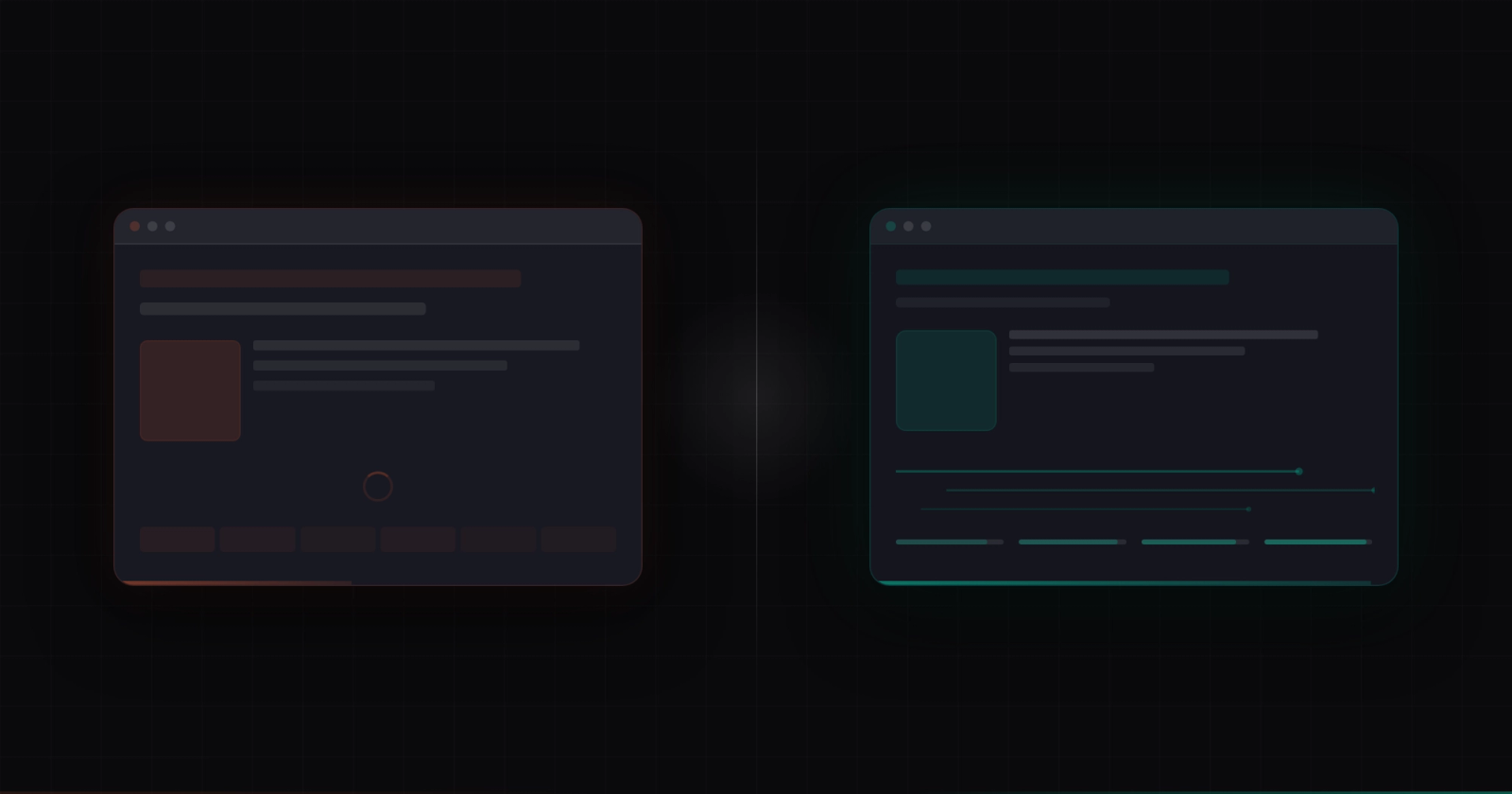
WordPress powers 43% of the internet. That is not a recommendation. That is a legacy.
Most Dubai businesses that come to us are running WordPress. Not because someone evaluated the options and chose it. Because their agency defaulted to it. Because it was familiar. Because "everyone uses it."
That logic made sense in 2015. In 2026, with international buyers researching from three time zones, patients comparing clinics at midnight, and hotel guests deciding between your direct booking and an OTA in under sixty seconds, the platform your business runs on is not a technical detail. It is a competitive advantage or a liability.
This article is not an opinion piece. It is a comparison based on measurable performance, real architecture differences, and what those differences mean for businesses in Dubai.
The numbers that matter
Google measures website performance through Core Web Vitals — three metrics that directly affect your search ranking, your bounce rate, and ultimately your revenue. Here is how the two platforms compare in production environments:
Core Web Vitals scores: • WordPress (average site with standard plugins): 40–70 • Next.js on Vercel (optimised build): 90–100
First Contentful Paint:
• WordPress: 2.5–4.5 seconds
• Next.js: 0.5–1.2 seconds
Time to Interactive:
• WordPress: 4–8 seconds
• Next.js: 1–2.5 seconds
Page weight:
• WordPress (with common plugins): 2–5 MB
• Next.js (code-split, optimised): 200–600 KB
These are not theoretical numbers. They are measured across production sites we have audited for Dubai businesses in real estate, medical, and hospitality.
Why does this matter? Google has confirmed that Core Web Vitals are a ranking signal. A site scoring 40 on performance does not compete equally with a site scoring 95 — even if the content is identical. For Dubai businesses spending AED 20,000 or more per month on SEO and advertising, sending that traffic to a slow website is burning money.
Architecture: the real difference
WordPress is a monolithic system. The database, the rendering engine, the admin panel, the plugins, and the front-end all live on the same server. Every page request hits that server, queries the database, assembles the HTML, and sends it to the browser. Every plugin adds weight. Every theme adds complexity. Every update introduces risk.
Next.js operates on a fundamentally different model. It is a React framework that pre-renders pages at build time or on demand, serves them from a global CDN, and separates the content layer from the presentation layer entirely. When paired with a headless CMS like Sanity, the architecture looks like this: Sanity manages the content — structured, queryable, accessible via API. Next.js renders the front-end — fast, optimised, deployed globally on Vercel. The two communicate through APIs, not through a shared database on a single server.
The practical result: a visitor in London accessing a Dubai real estate agency website gets the page from a CDN node in London, not from a server in Dubai. Load time drops from 4 seconds to under 1 second. That is not optimisation. That is architecture.
Security: what WordPress costs you quietly
WordPress is the most targeted CMS on the internet. Not because it is poorly built, but because it powers 43% of websites and relies on a plugin ecosystem where quality varies wildly. A single outdated plugin can expose your entire database.
Next.js with a headless CMS has no public-facing admin panel. There is no /wp-admin to attack. There is no database exposed to the front-end. The content API is read-only in production. The attack surface is fundamentally smaller.
For Dubai businesses handling sensitive client data — medical clinics with patient information, real estate agencies with buyer financials, hotels with booking details — this is not a technical footnote. It is a compliance requirement.
What WordPress cannot do
This is where the comparison stops being about performance and becomes about capability.
WordPress can display content. It can run a blog. It can process a contact form. With enough plugins, it can approximate e-commerce, membership systems, and basic automation.
What it cannot do — structurally, not because of a missing plugin — is operate as an intelligent platform. It cannot track individual visitor behaviour across sessions and build a profile. It cannot score visitors by intent and alert your sales team when a high-value prospect is active. It cannot connect a chatbot to your live CMS data so it answers questions accurately at 2am. It cannot generate and optimise SEO metadata across every page automatically. It cannot translate your entire site into Arabic with full RTL support driven by AI.
These are not feature requests. These are the capabilities that separate a passive website from a platform. And they require an architecture that WordPress was never designed to support.
When WordPress is still the right choice
Transparency matters. WordPress is not always the wrong choice.
If you are running a personal blog, a small portfolio site, or a brochure website that does not need to generate leads, track behaviour, or integrate with business systems — WordPress with a good theme is perfectly adequate. It is affordable, familiar, and has a massive ecosystem of tutorials and developers.
But if your website is your primary lead generation channel — if visitors arriving at your site represent real revenue opportunities — then the platform running underneath matters as much as the design on top. Speed affects conversion. Architecture determines what intelligence you can build. And in a market as competitive as Dubai, the businesses that win are the ones whose platforms work while their teams sleep.
The starting point
If your current website scores below 70 on Core Web Vitals, loads in more than 3 seconds, or treats every visitor the same regardless of their intent, the platform is the bottleneck, not the design.
ShapeShifters builds custom web platforms on Next.js and Sanity CMS for Dubai businesses in real estate, medical, and hospitality. Discovery calls are free and last 45 minutes.
shapeshifters.dev
Continue reading
→ Next.js vs WordPress vs Framer vs Webflow: The Honest Comparison for Dubai Businesses
→ What Is a Headless CMS? Why Sanity Powers the Best Modern Websites
→ Agentic Search Is Here. Your CMS Decides If You Survive It.
Written by
Alireza Chamanrouy
Lead Designer & Project Manager
Want a straight read on your own setup?
The first conversation is free, 45 minutes, no deposit. No proposal unless you ask for one.
Book the first conversation