Your Website Should Be a Lead Engine, Not a Brochure
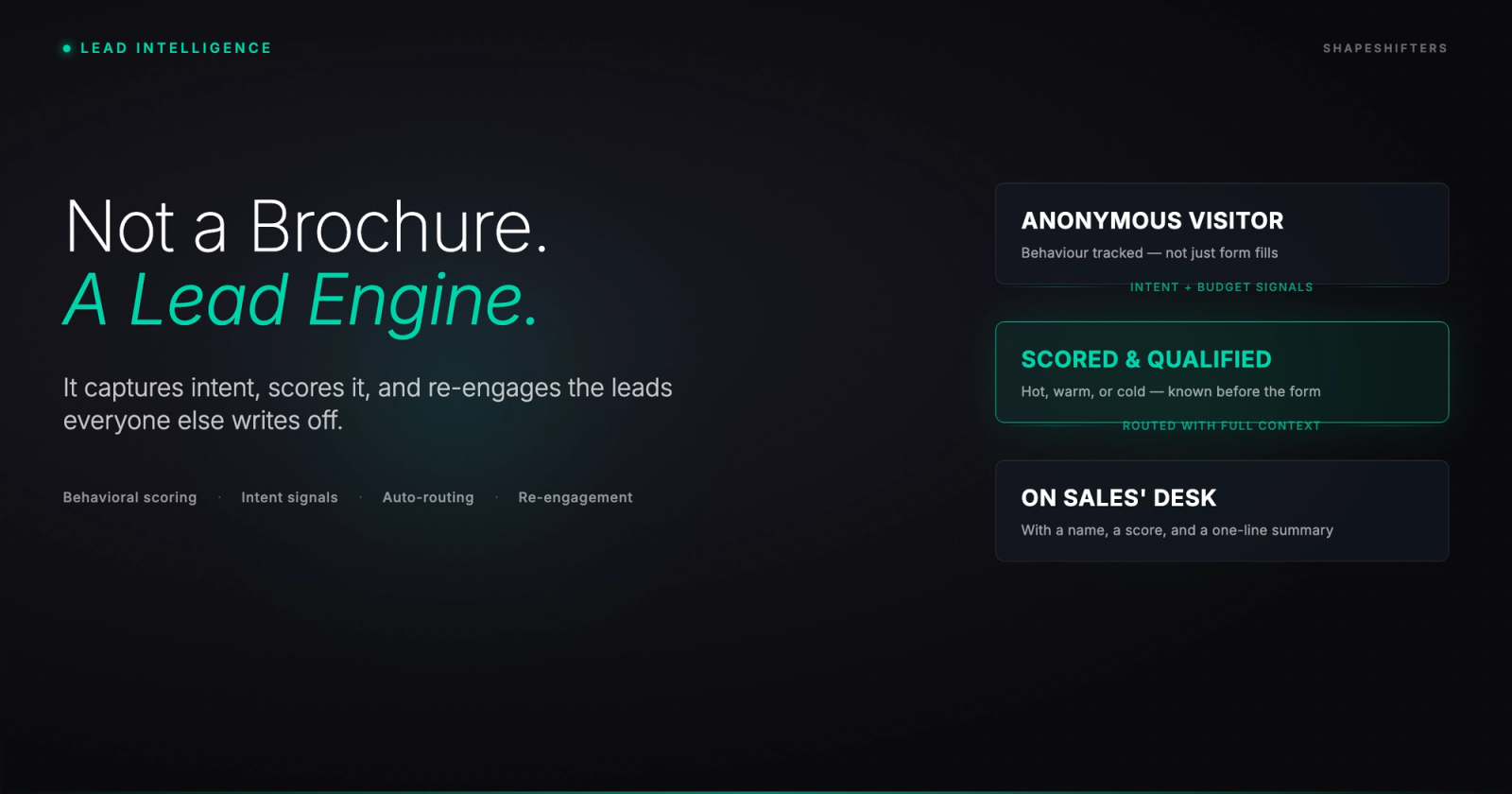
Most websites are brochures. They look the part, they list the services, they collect a name and an email — and then they wait. A brochure's whole job is to be looked at. It has no idea who's serious and who's browsing, no opinion about which visitor your sales team should call first, and no memory of the person who came back three times last week and never filled in the form.
A lead engine is a different machine. Its job is to figure out who's ready while they're still on the page, qualify them, hand the right person the context to follow up before the moment passes — and quietly go back to work on the leads everyone else has given up on.
Most Dubai businesses are paying good money for traffic to land on a brochure. Here's what the engine version actually does, and the build that proves it.
What a lead engine does that a brochure can't
Five things separate a system that generates leads from a page that merely displays a form:
- It reads behavior, not just form fills. Which pages someone lingers on, how long, whether they came back, what they downloaded, which property or procedure or service they kept returning to — those are intent signals. A brochure throws them away. An engine treats them as data.
- It scores readiness. Not everyone who fills a form is ready, and not everyone who's ready fills a form. A behavioral score tells your team who's actually warm, so they spend their hours on the right people.
- It routes with context. The right salesperson gets a name, a score, and a one-line summary of what this person cares about — not another anonymous entry in a noisy inbox.
- It re-engages the ones who slipped. The leads who didn't convert aren't dead. They're inventory. An engine works them on a schedule; a brochure forgets they ever existed.
- It proves itself. Which keyword became which visitor became which lead became which closed deal — tracked, attributed, and reported. No vanity metrics. Evidence.
That last point is the whole philosophy: your website should earn its retainer every quarter, with proof — not "engagement is up 17 percent."
The proof: turning a brokerage's dead pipeline back into inventory
The clearest demonstration of "leads are inventory" is a system we built for Roi'all Real Estate, a Dubai real estate company.
Every sales pipeline has a graveyard — leads that were once warm and went quiet. Most teams write them off. We built Roi'all an agent that treats that graveyard as stock to be worked.
It connects to the CRM, identifies the leads that have gone dormant, and runs a re-engagement cadence across WhatsApp and email — at sensible intervals, not a blast. Crucially, it doesn't send a canned template. Each message is drafted against the property that lead actually looked at, in the brokerage's brand voice, referencing the live listings — and when a buyer needs it, the agent assembles a bespoke brochure or document for that specific person on demand, because it has governed access to the codebase, the brand and design system, and the property data.
Then it gets better at it. When a salesperson edits a draft, ignores it, or sends it untouched, that signal teaches the agent how this particular desk writes and when it writes what. Over time it stops sounding like a generic copywriter and starts sounding like the team it works for.
A brochure could never do this. It doesn't know who went cold, can't tell a serious buyer from a tyre-kicker, and certainly can't write the follow-up. The engine does all three, quietly, between your team's logins.
"Collecting names" is the cheapest thing a website can do
Most real estate sites collect a name and an email. Most clinic sites collect a name and an email. Most financial-services sites collect a name and a phone number. Then a human is left to guess who's worth chasing.
A lead engine captures what actually matters — budget signals on a property page, procedure interest and patient origin on a clinic page, income and eligibility signals on a mortgage calculator — and acts on them automatically. The form is the last step, not the only one. By the time someone submits, you already know who they are and how ready they are.
This is why the engine model wins hardest in high-consideration markets — real estate, medical tourism, financial services — where a single qualified lead is worth a great deal and the cost of missing one is high.
The five layers that make it work
"Lead engine" isn't one feature — it's a small stack of capabilities working off a single record. We call it the Intelligence Operating System, and it has five layers:
- A site intelligence dashboard — one place that shows what your site is doing: who's on it, what's working, what changed. One number to glance at, not twelve tools to reconcile.
- AI-optimized SEO — finds the keywords real buyers use, writes the meta, tracks rankings, and ties each ranking post back to the leads and deals it produced.
- AI-content operations — researches, drafts in your brand voice, and stages articles for review, so the pipeline that feeds the top of the funnel doesn't stall.
- Behavioral lead intelligence — scores every visitor across page behavior, chatbot chats, downloads, and form activity, then routes the hot ones to sales with their full history attached.
- An AI chatbot — trained on your own content, answering visitors, capturing leads conversationally, and pushing the hot ones straight to WhatsApp with the transcript.
The point isn't the five boxes. It's that they share one spine, one identity per visitor, and one ledger — so the site reads from and writes to the same record instead of scattering it across separate tools that never agree. You can see the whole system here.
The same engine, tuned to your market
What counts as a "signal" depends entirely on what you sell, which is why a lead engine is configured per vertical rather than shipped as one generic widget.
- Real estate. A buyer who returns to a floor plan three times, lingers on a specific tower, and opens the brochure is telling you their budget and intent before they ever fill a form. The engine catches that, scores it, and routes the serious ones to an agent on WhatsApp while they're still warm.
- Medical tourism. A patient browsing from abroad is a different lead depending on the procedure they're reading about and where they're browsing from. Procedure interest, origin, and engagement with before-and-after galleries become a profile — so your team answers the ready ones first, before a faster clinic does.
- Financial services. A mortgage calculator isn't a widget; it's a profiling instrument. Every input — income, property value, deposit — is an eligibility signal that scores the prospect before the first call, so advisors stop spending meetings on people who were never going to qualify.
Same engine, different signals. That's the difference between "we have a contact form" and "we know who's worth calling."
Evidence, every quarter
The output of all this is not a dashboard full of pretty numbers. It's a ledger: the keyword that ranked, the traffic it delivered, the leads it produced, and the deals those leads closed — at 30, 60, and 90 days. One spine, one identity for each visitor, one record that sales, content, and marketing all read from and write to. Your website stops being a cost centre that "looks nice" and starts being an asset that can show its work.
Frequently asked questions
What's the difference between lead generation and lead intelligence?
Lead generation gets traffic to your site. Lead intelligence is what happens next — reading each visitor's behavior, scoring how ready they are, routing the hot ones to sales with context, and re-engaging the ones who went cold. You can buy all the traffic in the world and still lose the leads if the site just collects names and waits.
Does this only work if I have a lot of traffic?
No. Because the engine qualifies and re-engages the visitors you already have — including the dormant ones in your CRM — it often produces more from the same traffic before you spend a dirham more on ads.
What is behavioral lead scoring?
A score built from what a visitor actually does — pages viewed, time spent, returns, downloads, chatbot chats — rather than just the form they filled. It tells your team who's genuinely warm, so they spend their hours on the right people. More recent activity weighs more than old activity.
Do I have to replace my CRM?
No. The engine connects to the tools your team already uses and writes the scored, enriched lead into them — it keeps your systems in agreement rather than replacing them.
Is your website a brochure or an engine? If you're buying traffic that lands on a page which collects names and waits, we'll show you what the engine version would capture, score, and re-engage instead. Book a strategy call.
Related: Custom AI Agents & Automation → · The Intelligence Operating System →
Written by
Shape Shifter Team
Digital Growth Agency
Want a straight read on your own setup?
The first conversation is free, 45 minutes, no deposit. No proposal unless you ask for one.
Book the first conversation