Custom AI Agents & Automation: What "Code You Own" Actually Means
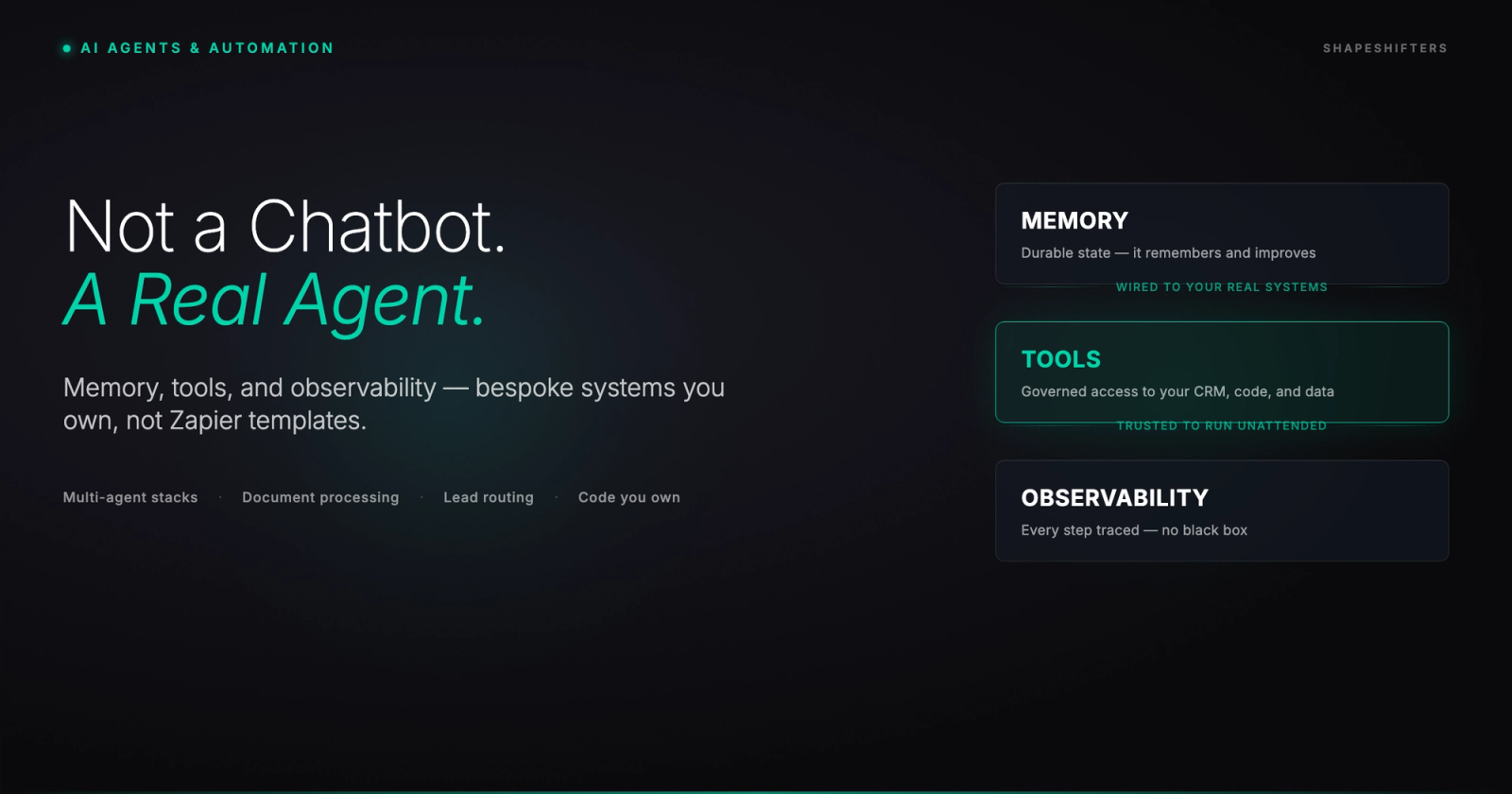
"AI agent" has quietly become the most oversold phrase in the market. Most of the time it describes a chatbot with a clever system prompt, or a single API call wrapped in a nice interface. That can be useful. It is not an agent.
A real agent is a system that can take a goal, decide what to do, use tools to do it, remember what happened, and be watched while it works. It runs a loop — observe, decide, act, check — not a script. And critically, it is software you own: code that lives in your stack, reads from and writes to your data, and answers to you rather than to a platform's roadmap and pricing page.
That distinction is not academic. It is the difference between an automation that quietly breaks the first time reality doesn't match the template, and one that earns trust because you can see exactly what it did and why. Below is what a real agent is made of, the work we've shipped, and an honest read on when you actually need one.
What a real agent is made of
Strip away the marketing and a production agent comes down to three things:
Memory. Not just the last message in a conversation — durable state. What it has already tried, what it learned, what a specific person told it last week. Without memory, every run starts from zero and the system can never get better at your particular business.
Tools. Real, governed access to the systems where work actually happens: your CRM, your codebase, your design system, your listings, your calendar, your document store. An agent without tools can only talk. An agent with tools can do.
Observability. Every step traced and inspectable. When an agent drafts a message, routes a lead, or extracts a number from a contract, you should be able to see the decision, the inputs, and the output — and catch a wrong turn before it reaches a customer. This is the part the no-code crowd skips, and it's the part that separates "demo that wowed the boardroom" from "system the team trusts on a Tuesday."
When those three are wired into a tested loop, you get something that behaves less like a macro and more like a junior team member who never sleeps, never forgets, and can be audited end to end.
Two systems we've built
The clearest way to explain the category is to show it. Here are two agents we've engineered — each impossible to assemble from off-the-shelf templates, each solving a specific, expensive problem. (A third — a lead-reactivation agent that turns a brokerage's dormant pipeline back into qualified conversations — is really a lead-intelligence story, so it gets its own deep-dive in Your Website Should Be a Lead Engine, Not a Brochure.)
1. A production agent that turns a brief into a finished video
Content operations are where good teams lose the most hours — for a property company, that's a constant stream of listing and brand videos. We built Roi'all Real Estate a production agent that turns a structured brief — the ingredients, and the kind of video wanted — into a finished, on-brand video through a code-driven pipeline, with five reusable templates covering the formats a brand actually ships.
The operator provides the inputs. The agent handles the path from there to a rendered, brand-consistent video, end to end. Because the pipeline is code rather than a timeline a human nudges by hand, the output is consistent, repeatable, and fast — and the templates mean the brand looks like itself every time, not like whatever a freelancer felt like that week.
That's the shape of real automation: not "AI makes a thing," but a system that takes the repetitive 80% off a team's plate so the humans spend their time on judgment, not assembly.
2. A render agent that puts real products into Mizanna Design's visuals
Mizanna Design, an interior-design studio, sells a promise: this is what your space will look like. The gap is that the beautiful render often contains generic, placeholder furniture — not the actual pieces the studio intends to source.
We built Mizanna an agent that closes that gap. It reads a rendering and the project's product palette, finds the real furniture pieces, and places them into the render — so the final image the client signs off is made of products that genuinely exist and can be bought, not stand-ins. The deliverable becomes both the pitch and the spec.
This is the kind of problem that looks small until you see the downstream effect: fewer surprises at handover, faster sign-off, and a sales conversation grounded in real, sourceable products. And there's much more in this class — agents that sit inside a specialist workflow and remove the exact friction that costs that business deals.
The shapes automation takes
Those two are agents in the fullest sense. Most engagements also include workhorse automations that are less glamorous and enormously valuable:
- Workflow automation — lead routing, calendar sync, document generation, internal notifications, triggered by webhooks, schedules, or events.
- Document processing — invoice extraction, contract review, form digitization, RFP responses. Structured output, validated against your schema, pushed downstream. The PDF nobody on the team wants to read becomes a row in your CRM.
- Lead routing & enrichment — inbound enquiries classified by intent, enriched from public sources, and routed to the right person with full context. The salesperson sees the lead before the visitor has closed the tab.
- Cross-platform sync — your CMS, Notion, Salesforce, and Slack kept in agreement, with conflict resolution and an audit trail. Your data lives in the tools your team chose; we keep them honest with each other.
- Internal tools — admin dashboards, approval workflows, custom CRMs for niche teams, and observability panels for the automations themselves.
The point is not to add AI for its own sake. The point is that your business runs on processes, and these are the systems that run them for you.
Why "code you own" is a business decision, not a preference
It would often be faster to wire these flows together on a no-code platform. We don't, and the reasons are commercial, not ideological:
- No vendor lock-in. When the logic lives in code you own, your automation isn't hostage to a third party's pricing changes, feature removals, or outages. You can move it, extend it, and audit it.
- Observability you can act on. Owned code can be traced, logged, and tested. When something goes wrong — and at scale, something always does — you can see the exact step that failed instead of staring at a visual canvas that says "error."
- Compliance and data residency. For a regulated financial firm or a clinic handling patient data, where the data flows and who can see it is not optional. Owned systems let us keep sensitive data inside your boundary and align with PDPL and your regulator by design — not bolt it on afterward.
"Bespoke, not templates. Code you own. No black box." That's the standard, and it's the reason these systems hold up in production rather than just in a demo. (For the full case on where no-code hits its ceiling, see When No-Code Stops Being Enough.)
The stack
For the technically minded buyers — the fintech founder, the operations lead — the engineering is deliberately boring in the best way: TypeScript and Python, Cloudflare Workers and Durable Objects for the runtime, Postgres and D1 for state, and the frontier models from Anthropic and OpenAI for reasoning, wired to your tools — Slack, your CRM, calendars, WhatsApp, webhooks. Boring, owned, observable infrastructure is what lets the interesting part run unattended.
Do you actually need this?
An honest gate, because not every problem needs an agent:
- If a task is occasional, low-stakes, and a person can do it in a few minutes, automate it later — or not at all.
- If a task is repetitive, high-volume, and follows judgment your team already applies consistently, that's the sweet spot — document processing, content assembly, routing, enrichment.
- If the cost of a quiet mistake is high — regulated data, money movement, client-facing output — you want owned, observable systems, not a black box.
The fastest way to know is to look at where your team loses hours to work they describe as "mindless but necessary." That's almost always where the first agent pays for itself.
See the work, not just the words. If you have a process that eats your team's week — document handling, content assembly, a specialist workflow nobody else can build for — we'll scope what a real, owned agent would do about it. Book a strategy call.
Related: Your Website Should Be a Lead Engine → · When No-Code Stops Being Enough →
Written by
Shape Shifter Team
Digital Growth Agency
Want a straight read on your own setup?
The first conversation is free, 45 minutes, no deposit. No proposal unless you ask for one.
Book the first conversation