When No-Code Stops Being Enough: From Templates to Real Agents
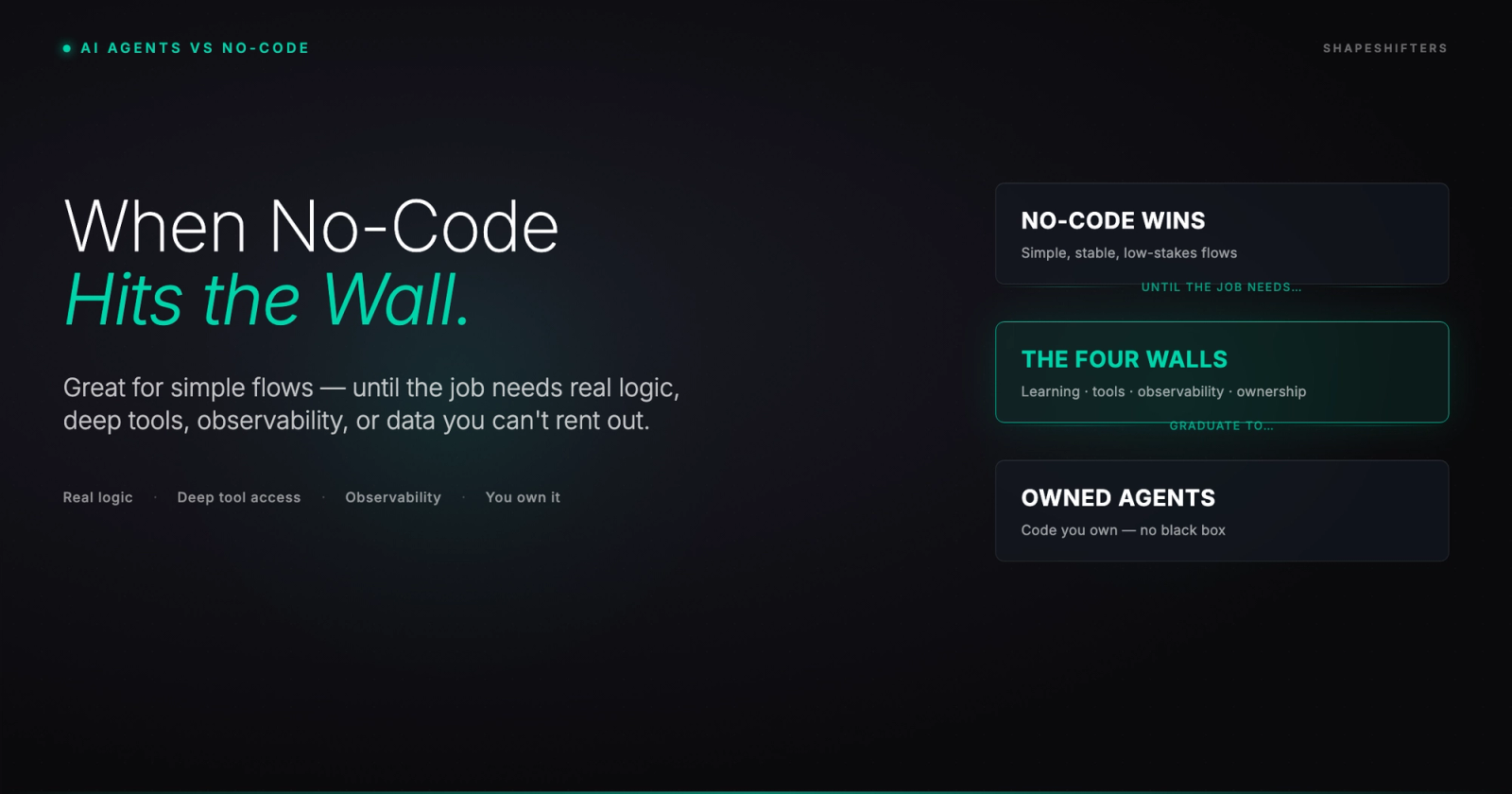
No-code automation deserves its popularity. If you need to connect a form to a spreadsheet, post a Slack message when a deal closes, or sync two apps that almost talk to each other, a no-code platform will have you running in an afternoon. For a huge number of jobs, that is exactly the right tool, and reaching for custom engineering instead would be a waste of money.
So this isn't an argument against no-code. It's an argument about the wall — the point where a no-code automation stops being a shortcut and starts being a liability. Most teams hit it without realizing, and the symptoms are familiar: the automation that needs a human to babysit it, the flow that breaks silently and loses leads for a week before anyone notices, the "AI" that can't actually do the one thing you hired it for.
There are four walls. The useful thing isn't to argue them in the abstract — it's to show each one with a system where a template would have failed, and code that didn't.
Where no-code genuinely wins
First, fairness, because the wall only matters if you know which side you're on. Stay on no-code when the task is simple, the data isn't sensitive, the steps are stable, and a quiet failure costs you little. A new-lead notification, a calendar sync, a tidy hand-off between two well-behaved apps — wire it up, ship it, move on. Don't let anyone sell you engineering you don't need.
The trouble starts when the job has real logic, needs to reach deep into your systems, has to be trusted with customers, or holds data you can't afford to rent out. That's where the walls are.
Wall 1 — Real logic and learning
A template sends the same thing to everyone. The moment the output has to adapt — and especially the moment it has to improve — you've left no-code.
Our clearest example is a reactivation agent we built for Roi'all Real Estate that works the brokerage's dormant leads. The part no template can touch is that it learns: when a salesperson edits a draft, ignores it, or sends it untouched, that signal trains the agent on how this specific desk writes and when. It gets better at the job the longer it does it. No visual canvas models "learn the rhythm of this sales team." Owned code, with memory and a training signal, does. (The full story of that build — and why it's really about lead intelligence — is in Your Website Should Be a Lead Engine.)
Wall 2 — Deep tool access
No-code platforms connect to apps through pre-built integrations. The instant you need an action the integration doesn't expose, you're stuck waiting for a connector that will never come.
Two builds make this concrete. For Mizanna Design, an interior-design studio, we built an agent that places real furniture pieces into project renderings — which means reaching into the studio's specific product palette and design tools, something no off-the-shelf connector offers. And the same Roi'all agent assembles bespoke brochures on demand by reaching into the codebase, the brand and design system, and the live property listings all at once. Real tool access means writing the tools — governed and observable — against your actual systems. That's engineering, not configuration.
Wall 3 — Observability and trust
If an automation talks to your customers in your name, a wrong move isn't a bug ticket — it's a damaged relationship. No-code platforms are notoriously hard to debug at scale: when a multi-step flow fails, you're left clicking through a visual canvas trying to reconstruct what happened.
A production agent traces every step — the inputs, the decision, the output — so a bad draft or a mistimed follow-up is caught before it reaches a customer, and so the team trusts the system enough to let it run unattended. You cannot let an automation speak for your brand if you can't see what it's saying. Observability is the price of autonomy, and it's exactly the part the no-code crowd skips.
Wall 4 — Ownership, lock-in, and compliance
The most valuable workflows are the ones built on your most valuable data — and running those through a third-party no-code platform means your core system now lives on someone else's infrastructure, subject to their pricing, their outages, and their terms.
The sharpest illustration is the platform we built for eplanetbrokers: a multi-tenant system with its own page builder, templates, and role-based access that runs like a SaaS product — except they own it. They aren't a tenant paying rent forever inside someone else's limits; the templates, the rules, the data, and the IP are theirs. That's the difference between renting your most important system and owning it. And in the UAE it's not only commercial: for a regulated financial firm or a clinic handling patient data, keeping data inside your boundary and aligned with PDPL by design isn't a preference, it's the requirement — and you can't guarantee it on infrastructure you don't control.
So when do you graduate?
A practical framework, written from the buyer's chair:
Stay on no-code when the task is simple, the data isn't sensitive, the steps are stable, and a quiet failure costs you little.
Graduate to owned, custom systems when any of these are true:
- the output has to adapt or learn (per customer, per salesperson, per case),
- it needs tools no connector offers (your codebase, design system, proprietary data),
- a mistake is expensive or public (client-facing messages, money, regulated data), or
- the workflow is core to the business and you can't afford to rent it.
The tell is usually this: you find yourself fighting your no-code platform to make it do the one thing that actually matters — and every workaround makes it more fragile. That's the wall. Past it, the cheaper path is the one you own.
Already fighting the wall? If you have an automation that keeps breaking, can't quite do the important part, or holds data you'd rather not rent out, we'll tell you honestly whether it needs real engineering — and what that would look like. Book a strategy call.
Related: Custom AI Agents & Automation: What "Code You Own" Means → · When You Need a Platform, Not a Website →
Written by
Shape Shifter Team
Digital Growth Agency
Want a straight read on your own setup?
The first conversation is free, 45 minutes, no deposit. No proposal unless you ask for one.
Book the first conversation