When You Need a Platform, Not a Website
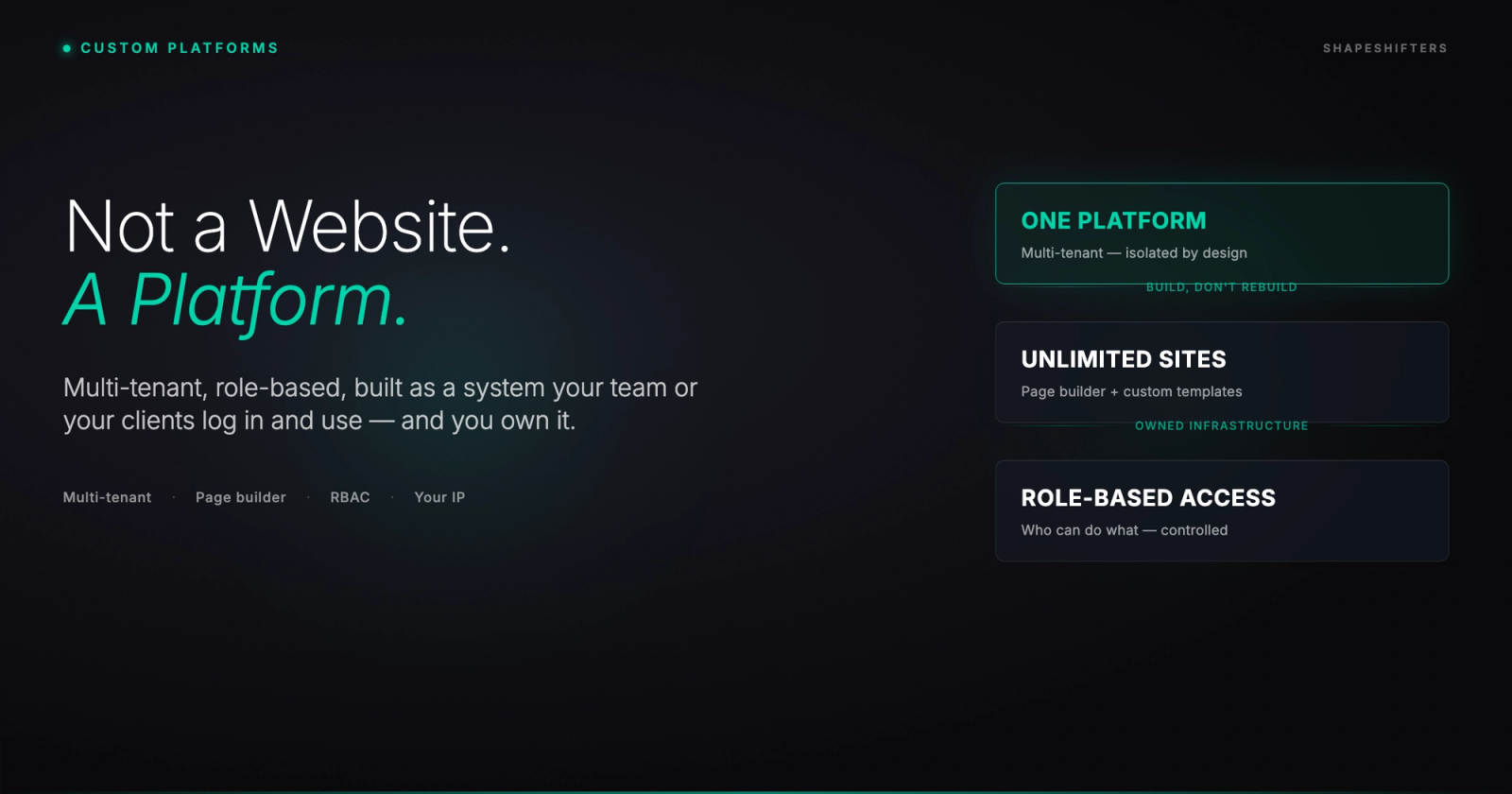
A website is a destination. A platform is a system other people use to get work done. They look similar from the outside — both live in a browser — but they are completely different things to build, and confusing one for the other is expensive in both directions. Build a platform when you needed a website and you've burned a budget. Build a website when you needed a platform and you'll be back in eighteen months, frustrated, having outgrown it.
Most "we need a better website" conversations are exactly that — a website. But a growing number aren't. They're really "we need software," and nobody has said it out loud yet. Here's how to tell the difference, and what it looks like when the answer is a platform.
The signs you've outgrown a website
You're past website territory when more than one of these is true:
- Many separate spaces, one system. Multiple teams, branches, brands, or clients each need their own controlled area — their own pages, their own data, walled off from each other. That's multi-tenancy, and no off-the-shelf site handles it cleanly.
- Different people, different permissions. An admin, an editor, a viewer, a client who can only touch their own corner. When access control becomes a real requirement, you need a role-based system, not a login.
- You're rebuilding the same thing over and over. If your team is hand-making the fortieth near-identical page, you don't need more pages — you need a builder and templates so they can make their own, unlimited, without calling a developer.
- You want to offer it to your own customers. The moment the thing you're building is something your clients would log into and use, you're not building a website anymore. You're building a product.
- Your point tools are duct-taped and breaking. A CRM, a form tool, a CMS, three spreadsheets, and a chatbot, all glued together and falling apart at the seams — that's usually a platform trying to be born.
The proof: a brokerage platform that runs like its own SaaS
The clearest example we've built is for eplanetbrokers — a fully custom, multi-tenant platform, not a website.
Inside it sits a page builder with custom templates, so the team can spin up unlimited pages — entire websites — without touching code, all governed by a role-based access system that controls who can do what. In practice it behaves like a SaaS product in its own right: the way a business would use Wix to launch sites, eplanetbrokers uses this. The difference is ownership. They aren't a tenant on someone else's platform, paying rent forever and living inside someone else's limits. The templates are theirs, the rules are theirs, the data is theirs, the IP is theirs. They own the platform other people would have rented.
That's the line between a website and a platform in one build: a website is something you have made; a platform is something you can keep making things with.
What platform engineering actually involves
The reason a platform costs and weighs more than a website is the machinery underneath:
- Multi-tenancy and isolation — many tenants on one system, each one's data sealed off from the others, reliably, every time.
- Role-based access control (RBAC) — granular permissions, so the right people can do exactly what they should and nothing they shouldn't.
- A real builder — templates, components, and an editing experience that lets non-technical users create freely inside guardrails you set.
- Performance and reliability at scale — a platform has to hold up when it's not one site getting traffic, but many.
- The unglamorous infrastructure — the auth, the data model, the audit trail, the deployment pipeline that keeps all of it from stepping on itself.
None of that is visible on the surface, and all of it is the difference between a platform that lasts and a prototype that wowed everyone in the demo and fell over in month three.
Multi-tenancy and RBAC, in plain English
Two terms do a lot of the heavy lifting when we talk about platforms, and they're worth saying plainly.
Multi-tenancy means one system serving many separate "tenants" — teams, branches, brands, or clients — each with their own walled-off space and data, while sharing the same underlying software. Done right, tenants never see each other's data, an update ships to everyone at once, and you can add a new tenant without building anything new. It's the difference between running one platform and maintaining fifty copies of a website by hand.
Role-based access control (RBAC) means people get permissions based on their role, not blanket access. An admin can do everything; an editor can publish but not change settings; a client can touch only their own corner. As soon as more than a couple of people work in a system — or you let customers in — RBAC stops being a nice-to-have and becomes the thing that keeps the platform safe and sane.
Most off-the-shelf website tools fake one or both of these, or bolt them on awkwardly. A real platform is built around them from the first line of code.
Own the platform — don't rent it
The strategic reason to build rather than subscribe is ownership. A custom platform is code you own: your IP, your infrastructure, no per-seat tax that compounds forever, no vendor lock-in, no roadmap you don't control deciding what your business can and can't do. And for a regulated UAE business, it means your data can live inside your boundary, aligned with PDPL and your regulator by design — not wherever a third-party SaaS happens to host it.
When it's worth it — and when it isn't
An honest gate, because not every brief is a platform:
- If you need a brilliant site that captures and converts, build that — and make it a lead engine, not a brochure. Don't let anyone sell you a platform you won't use.
- If many users will create and manage many things under one roof, with different permissions, and especially if you'd one day offer it to your own clients — that's a platform, and a website will only frustrate you.
Custom platforms are an enterprise-tier investment (it's where the AED 100k+ engagements live), and that number is a function of how much real machinery the build needs. What actually drives the cost is here.
The quick test: website or platform?
If you're still unsure, run these questions. Each "yes" pushes you toward a platform:
- Will different people or organizations each need their own private space inside it?
- Do different users need different permissions — some who can edit, some who can only view, some who can only touch their own data?
- Will non-technical people need to create new pages or sites themselves, repeatedly, without a developer?
- Is this something your own customers would eventually log into and use?
- Are you currently holding the thing together with a stack of separate tools that keep breaking?
One "yes" might just mean a well-built website with the right features. Three or more, and you're describing a platform — and forcing it into a website will cost you more in the long run than building it properly the first time.
Frequently asked questions
What's the difference between a website and a platform?
A website is a destination people visit. A platform is software people log into and use to get work done — with accounts, permissions, and the ability to create and manage things inside it. If users mostly read it, it's a website. If users operate it, it's a platform.
What is a multi-tenant platform?
One system that serves many separate tenants — teams, brands, or clients — each with their own isolated space and data, sharing the same underlying software. It's how a single platform can power unlimited sites or accounts without rebuilding anything for each one.
Can a custom platform work like Wix or a SaaS product?
Yes — that's exactly what we built for eplanetbrokers: a page builder with templates that spins up unlimited sites, governed by role-based access, behaving like a SaaS product. The difference is ownership — it's theirs, not rented.
Do I own the platform and its code?
Yes. Custom platforms are built as code you own — your IP, your infrastructure, no vendor lock-in and no per-seat tax that compounds forever. At the enterprise tier that includes full IP ownership and dedicated infrastructure.
How much does a custom platform cost?
Platforms are the enterprise tier, with engagements starting at AED 100,000+, scaling with how much real machinery the build needs. What drives the cost is here.
Not sure which one you need? Tell us what your team — or your clients — would actually do inside it, and we'll tell you honestly whether it's a website or a platform, and what building it the owned way would involve. Book a strategy call.
Related: What a Custom Platform Actually Costs in Dubai → · Your Website Should Be a Lead Engine →
Written by
Shape Shifter Team
Digital Growth Agency
Want a straight read on your own setup?
The first conversation is free, 45 minutes, no deposit. No proposal unless you ask for one.
Book the first conversation