What a Custom Platform Actually Costs in Dubai — and What Drives the Price
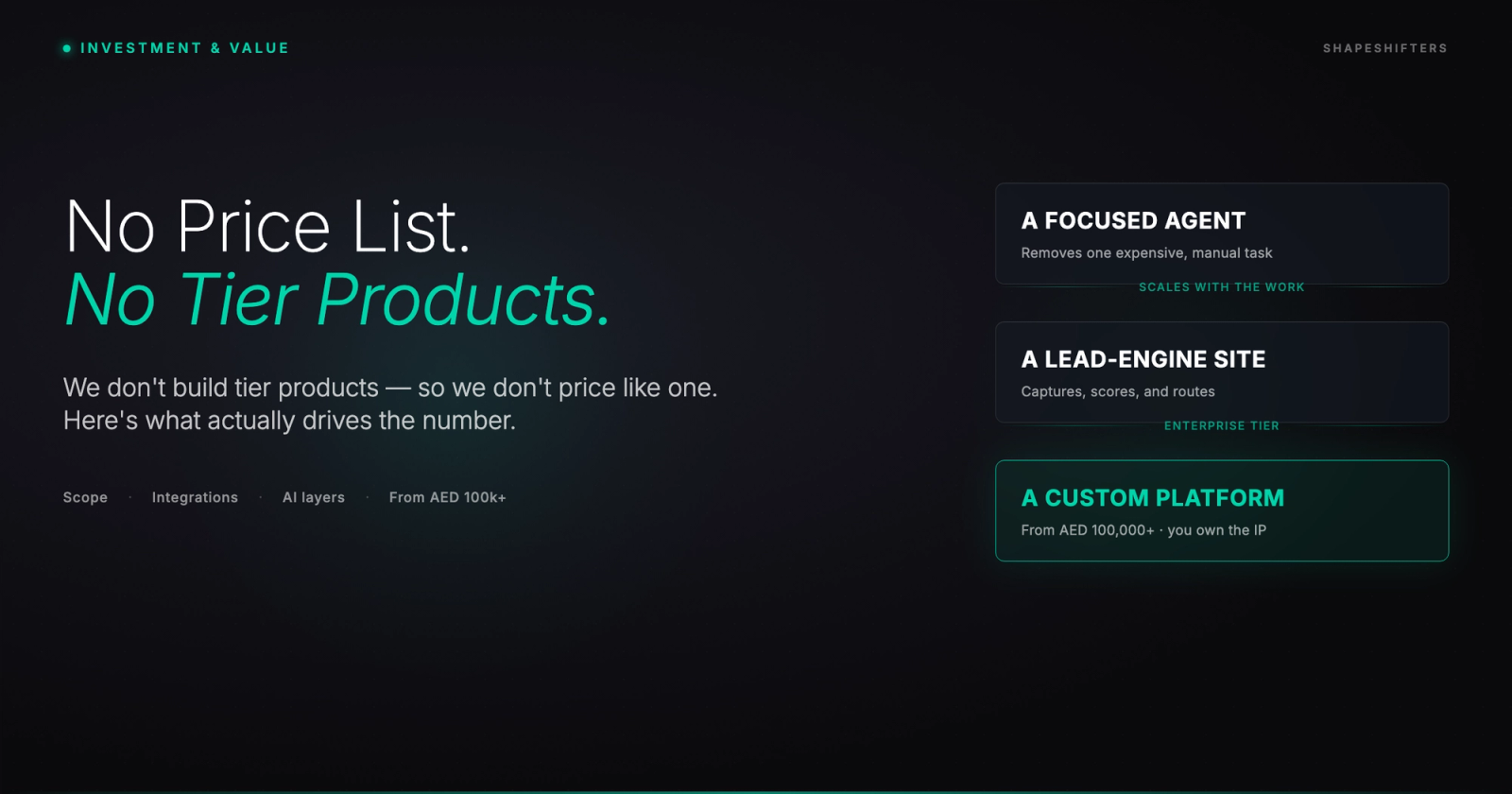
We don't publish a price list, and the reason is straightforward: we don't build tier products. A number on a pricing page is only useful if everyone is buying the same box. The moment what you're buying is engineered around your business — your verticals, your pipeline, your integrations — a fixed tier stops meaning anything. So instead of a fake price, here's the honest version: what actually moves the number, and the real ranges so you can place yourself on the map before you ever get on a call.
Why "how much is a website" is the wrong question
Most cost guides in Dubai answer a question that doesn't really exist. "How much does a website cost" has the same answer as "how much does a building cost" — it depends entirely on whether you're putting up a kiosk or a tower. The useful question is: what am I actually buying, and what makes it cost what it costs?
There are five real drivers:
- Scope — what kind of system is it? A single, focused automation or agent is one thing. A website wired as a lead engine is more. A full multi-tenant platform with a page builder and role-based access is another order of magnitude. These aren't the same product at different prices; they're different machines.
- The intelligence layer. Behavioral lead scoring, AI content operations, AI-optimized SEO, a chatbot trained on your business — each capability you add is real engineering, not a checkbox.
- Integration work. Connecting cleanly to your CRM, payment, calendar, ERP, or a regulator's system is where a lot of the real effort lives. A simple connection is quick; a bespoke, real-time data flow between systems that weren't designed to talk takes more.
- Language and architecture. True bilingual with native RTL Arabic is a fundamentally different architecture from English-only — not a translation toggle bolted on at the end.
- Timeline. A compressed four-week build costs more than the standard eight-to-twelve-week one, because speed has to be bought with focus.
The honest anchors
To place yourself roughly:
- A focused agent or automation — something like a single document-processing or lead-routing system — is the most accessible tier. It pays for itself by removing a specific, expensive piece of manual work, and it's a fraction of a platform.
- A website built as a lead engine sits in the middle — a real site, plus the intelligence layer that makes it capture, score, and route instead of just collect names.
- A custom multi-tenant platform — the kind of system where your team or your clients log in and build, with templates and permissions, owned outright — is the enterprise tier, starting at AED 100,000+, with full IP ownership and dedicated infrastructure.
The investment scales with the work, not with a package you've been slotted into. A brokerage that needs a whole platform and a clinic that needs one sharp automation should not be quoted from the same menu, because they aren't buying the same thing.
What you're actually buying
It's easy to compare the upfront number against a cheap template and feel the gap. The gap is real, and so is what it buys:
- Ownership. Code you own, IP you keep, infrastructure that's yours — not a subscription that taxes every seat forever and disappears the day you stop paying.
- No rebuild in eighteen months. Cheap builds are cheap because they're disposable. A system engineered around your business is built to be extended, not thrown away and redone — which is where the real money goes when you get this wrong.
- Evidence. Done right, the system shows its work — which content became which lead became which deal — so the spend is accountable instead of a leap of faith.
- No black box. Observable, auditable, compliant by design. For a regulated financial firm or a clinic handling patient data, that isn't a luxury; it's the requirement.
The most expensive website is the cheap one you build twice.
What each engagement actually includes
Because the work scales, so does what's in the box. Here's what each kind of engagement typically covers — described by scope, not by a price tag, because the same tier means different things for different businesses.
A focused agent or automation. One clearly-defined system that removes a specific, expensive piece of manual work — document processing, lead routing and enrichment, a reactivation cadence. Scope is tight: the agent, the tools it needs into your existing systems, observability so you can trust it, and a hand-off into wherever the work already lives. It's the fastest thing to ship and the easiest place to start, because it pays for itself against a cost you can already name.
A website built as a lead engine. A real, designed site — and the intelligence layer underneath it that turns visits into qualified, scored, routed leads. That means behavioral tracking, a scoring model tuned to your business, a chatbot trained on your content, CRM integration, and the attribution that proves which content produced which deal. You're not buying pages; you're buying a system that earns its keep.
A custom multi-tenant platform. The enterprise tier — software your team or your clients log into and build with: a page builder, templates, role-based access, isolated tenants, dedicated infrastructure, and full IP ownership. This is where engagements start at AED 100,000+, because the machinery underneath is a different order of engineering from a single site.
The line between these isn't a discount or an upsell. It's a different machine for a different job — and most of the cost conversation is really about working out which one you actually need.
The real cost is the one you pay twice
The upfront number is the visible cost. The expensive one is hidden, and it shows up later.
A cheap template feels like a saving until you've outgrown it in eighteen months and pay again to rebuild — this time migrating content, redirecting URLs, and explaining to your team why the "new" site looks like everyone else's. A rented no-code stack feels lean until the per-seat fees compound, a price change lands, or the one workflow that matters can't be done inside the tool. And a brochure that doesn't capture or qualify anything has a cost that never appears on an invoice at all: the qualified leads it quietly loses every month.
Total cost of ownership is the honest frame. A system engineered around your business and owned outright is built to be extended, not replaced — so the second-year cost is improvement, not reconstruction. The data and the IP are yours, so there's no rent that grows forever and no platform that can change the rules underneath you. That's why the cheapest option on day one is so often the most expensive one by year two.
How we actually quote
No padding, no mystery line items, no hourly surprises. We map the scope and the deliverables, price it as a fixed engagement, and you know what you're paying before work starts. The first step is a conversation about what the system needs to do — because that, not a tier, is what determines the number.
Frequently asked questions
How much does a website cost in Dubai?
Honestly, it depends on what the website has to do. A simple brochure site and a multi-tenant platform with a built-in intelligence layer are different machines, and quoting them from the same menu would be meaningless. What's consistent is the approach: we scope what you actually need, price it as a fixed engagement, and tell you what drives the number before you commit.
Why don't you publish your prices?
Because we don't build tier products. A price list only helps when everyone buys the same box; everything we build is engineered around a specific business, its verticals, and its pipeline. A fixed-tier price would either over-charge the simple job or under-deliver the complex one.
What's the most affordable way to start?
A single focused agent or automation — something that removes one expensive, manual task. It's the smallest scope, ships fastest, and pays for itself against a cost you can already point to. Many engagements grow from there.
How long does a build take?
A standard build runs eight to twelve weeks. A compressed timeline — around four weeks — is possible for the right scope, but speed is bought with focus, so it costs more than the standard path.
Do I own what you build?
Yes. Custom engagements are code you own — your IP, your infrastructure, no vendor lock-in. At the enterprise tier that includes full IP ownership and dedicated infrastructure outright.
What does an AED 100,000+ engagement include?
That's the enterprise tier — typically a custom multi-tenant platform with a page builder, templates, role-based access, dedicated infrastructure, and full IP ownership. The exact figure scales with how much real machinery the build needs.
Want a real figure for your situation? Tell us what you're trying to build and what it has to connect to, and we'll scope it honestly — what it would cost, what drives that, and where you could start smaller. Book a strategy call.
Related: When You Need a Platform, Not a Website → · Your Website Should Be a Lead Engine →
Written by
Shape Shifter Team
Digital Growth Agency
Want a straight read on your own setup?
The first conversation is free, 45 minutes, no deposit. No proposal unless you ask for one.
Book the first conversation